
Premiere of the Play “Crocodile” Produced by Opera Lab (Serbia) at the Small Stage of the Little Theatre "Duško Radović"
On Thursday, February 12 at 8 PM, the play “Crocodile” will premiere at the Small Stage of the Duško Radović Little Theatre, directed by Ana Grigorović and produced by Opera Lab (Serbia). The performance is intended for audiences aged 12+ as well as adults. The creative process began with a workshop for young people aged 18 to 25, inspired by the monodrama “Crocodile,” in partnership with the organization Atrium (North Macedonia). The activity was supported by the Regional Youth Cooperation Office (RYCO) – WB Youth Cultural Fund.
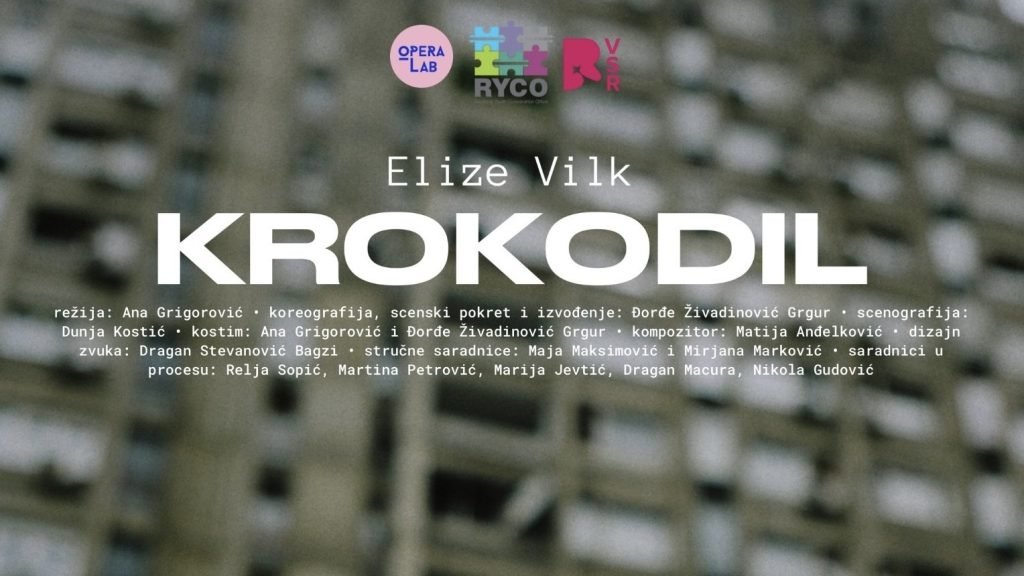
Elise Wilk
CROCODILE
Director: Ana Grigorović
Choreography and Stage Movement: Đorđe Živadinović Grgur
Set Design: Dunja Kostić
Costume Design: Ana Grigorović and Đorđe Živadinović Grgur
Composer: Matija Anđelković
Sound Design: Dragan Stevanović Bagzi
DAVID – ĐORĐE ŽIVADINOVIĆ GRGUR
Professional Associates: Maja Maksimović and Mirjana Marković
Process Collaborators: Relja Sopić, Martina Petrović, Marija Jevtić, Dragan Macura, Nikola Gudović
Crocodile is a contemporary monodrama about a boy trying to survive in a world that has no place for his difference. The author, Elise Wilk, received the National Award for Monodrama in 2017 for this play, which is being performed in Serbian for the first time.
The main character, eleven-year-old David, faces the loss of his father, neglect within his family, and violence at school, while at the same time trying to understand his own identity and his feeling of not belonging. In societies shaped by rigid, binary views of gender and sexuality, children and young people who do not fit in are often left without a voice, without protection, and without space to make mistakes. Their silence becomes accepted, and the violence against them normalized. Crocodile speaks precisely from that silence.
The performance follows the inner world and turning points in the boy’s early adolescence. Gender-nonconforming, withdrawn, and invisible, he endures verbal and physical peer violence and the misunderstanding of adults who minimize, ignore, or fail to see his experience, preoccupied with their own problems. What David cannot or does not dare to express returns to him as pain — in the form of a crocodile that bites him from within. When pain is not given a name, it grows and begins to bite.
Yet the most challenging circumstance in this boy’s life is not the noise of violence, but the quiet, persistent loneliness that lasts for years, throughout a childhood without support.
Crocodile offers the perspective of a child growing up in a world where difference is a reason for punishment or neglect rather than care and tenderness. It addresses both young people and adults, opening questions about the responsibility of the community toward children growing up under the pressure of norms, expectations, and violence. It is a call to listen more carefully, to look where we usually avert our gaze, and to consider the many ways we can make life easier for children who are seen as different — and above all, to ask ourselves how we can be their friends and allies.